
Why your home organising efforts fail: 8 common mistakes that sabotage success
You’ve watched the organising shows, bought the books and dashed to Ikea for beautiful storage solutions, then spent a weekend tackling that hectic wardrobe. Yet somehow, within weeks (or days), the floordrobe is thriving, and it’s chaos as usual. Sound familiar? You’re not alone.
As a professional organiser, I see the same patterns repeatedly. The good news is that organising blunders aren’t a moral failing. They’re usually the result of common misconceptions. Here are the eight biggest reasons why your home organising efforts fail – and how to avoid them.
1. You keep too much stuff
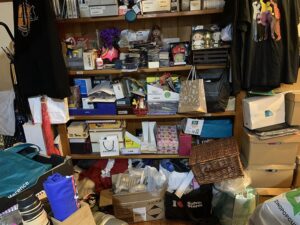
This is the biggest problem. I’m not preaching minimalism but truth time: no organising system in the world can make an overcrowded space functional. It’s like rearranging the deck chairs in the Titanic. If every wardrobe, drawer, and cupboard is packed to capacity, even the most brilliant organisation will fail.
Many people resist decluttering because they feel wasteful getting rid of things they spent money on. But remember – you can’t get your money back but you CAN get your space back.
The reason: Decluttering is hard, I get it.
The fix: Be honest about what you actually use and need. The less you keep, the easier and stickier the organising.
2. You focus on containers before decluttering
Those gorgeous acrylic bins and matching baskets make every Pinterest pantry pop. But buying containers before decluttering is like buying a garage before you know how many cars you own.
When you shop for storage first, you don’t necessarily know where the containers will go. And/or you try to make your stuff fit the containers rather than finding containers that fit your actual needs. You end up cramming items into spaces that don’t make sense, or worse, you use the new containers as an excuse to keep things you should have donated. And the containers can become another thing to declutter. Get things OUT before you bring anything IN.
The reason: Shopping is fun, and we (and marketers) talk ourselves into the notion that containers solve our problem.
The fix: Always declutter first. Get rid of what you don’t need, then measure and assess what storage solutions work best for what remains.
3. You keep acquiring
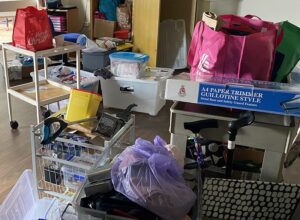
You can’t organise your way out of a shopping problem. If new items constantly flow into your home without anything leaving, even perfect organisation will quickly become chaos again. Turn off the tap, or the sink overfloweth.
This doesn’t mean you can never buy anything new. It means being intentional about what comes into your space and having a plan for where it will go.
The reason: As above, shopping provides a dopamine hit. It’s easy and satisfying – at least in the short term.
The fix: Implement a “one in, one out” rule, or better yet, a “one in, two out” rule until you reach a comfortable amount of stuff. Before buying anything, ask yourself where it will live and what purpose it will serve.
4. You overfill containers and spaces
Stuffing containers and spaces to 100% capacity is a recipe for failure. When there’s no room to grow or move, the system breaks down the moment you need to put something away quickly or retrieve something from the bottom of a pile.
Overstuffed spaces also make maintenance feel overwhelming. When you have to move ten things to put away one item, you’ll inevitably start leaving things out instead.
The reason: Stuff costs money and decluttering is hard; therefore, we feel entitled to keep as much as the container will allow, even if it’s bulging.
The fix: Fill containers and spaces to max 80% capacity. Leave room for things to move and breathe. Your future self will thank you when putting things away is quick and easy.
5. You don’t label
“I’ll remember where everything goes” is what we all tell ourselves. But memory is unreliable, especially when life gets busy or other family members need to use the system.
Without labels, organised spaces quickly unravel, and items get shoved into whatever container seems convenient at the time.
The fix: Label everything, even if it seems obvious. Labels aren’t just for you – they’re for your stressed, tired and forgetful future self, and for anyone else who lives in or visits your home.
6. Your categories are overly complicated or don’t make sense
Creating categories that look good on paper but don’t match how you live is a fast track to failure. If you create categories so specific that you can’t remember which container holds what, or you put incongruent items together so that you need a label as long as your arm, your system will collapse. Also if it’s a category you rarely use, you don’t need to micro-sort it because you won’t see much benefit and may hit burnout on colour-coding your pencils.
The best organising categories mirror your natural habits and thought processes, and are not what looks prettiest or most logical to someone else.
The reason: Sometimes we get into hyperfocus, or we want to make the most of all the containers we bought (see point #2), or we are copying someone else’s system.
The fix: Organise according to how you actually use things, not how you think you should use them. Group like with like or by the tasks they’re used for, and ensure your label reflects that. Make it so simple that your tiredest self and other family members can keep up.
7. You don’t adapt your systems
Life changes, and your organising systems need to change with it. A system that worked perfectly when your children were toddlers might be completely wrong now that they’re teenagers. A wardrobe with corporate clothes front and centre, will be clunky if you are working from home and wearing leisure wear daily.
Many people stick with organising systems long after they’ve stopped working, out of inertia or because they feel like giving up on a system means failure.
The fix: Regularly identify flaws and assess whether your systems still serve your current needs. It’s not failure to change a system – it’s smart maintenance.
8. You create barriers to maintenance
The most beautifully organised space in the world will fail if maintaining it is complicated, time-consuming, or requires multiple steps. If putting something away means moving three other things and opening two containers, that item is going to end up elsewhere. Don’t stack tubs if you need high access to the bottom one. Don’t even have lids on tubs that are in daily use. Don’t decant products into pretty jars if you don’t want the hassle (I know I don’t).
Complex systems work in magazines and social media posts, but they rarely work in real life, especially during busy periods.
The fix: Make maintenance as easy as possible. The best organising system is the one you’ll actually use consistently, not the one that looks most impressive.
The bottom line
Successful home organisation isn’t about perfection – it’s about creating systems that work with your life. By avoiding these eight common mistakes, you’ll set yourself up for organising success that actually lasts.
Remember, organising is a skill that improves with practice. Be patient and curious with yourself as you learn what works for your specific situation, and don’t be afraid to adjust systems as you go. The goal is progress, not perfection.
Sometimes chatting a Professional Organiser can help you tailor great systems for you.